

Rockmelon – Spherical Formations that Resemble Art – (Natural Heritage)
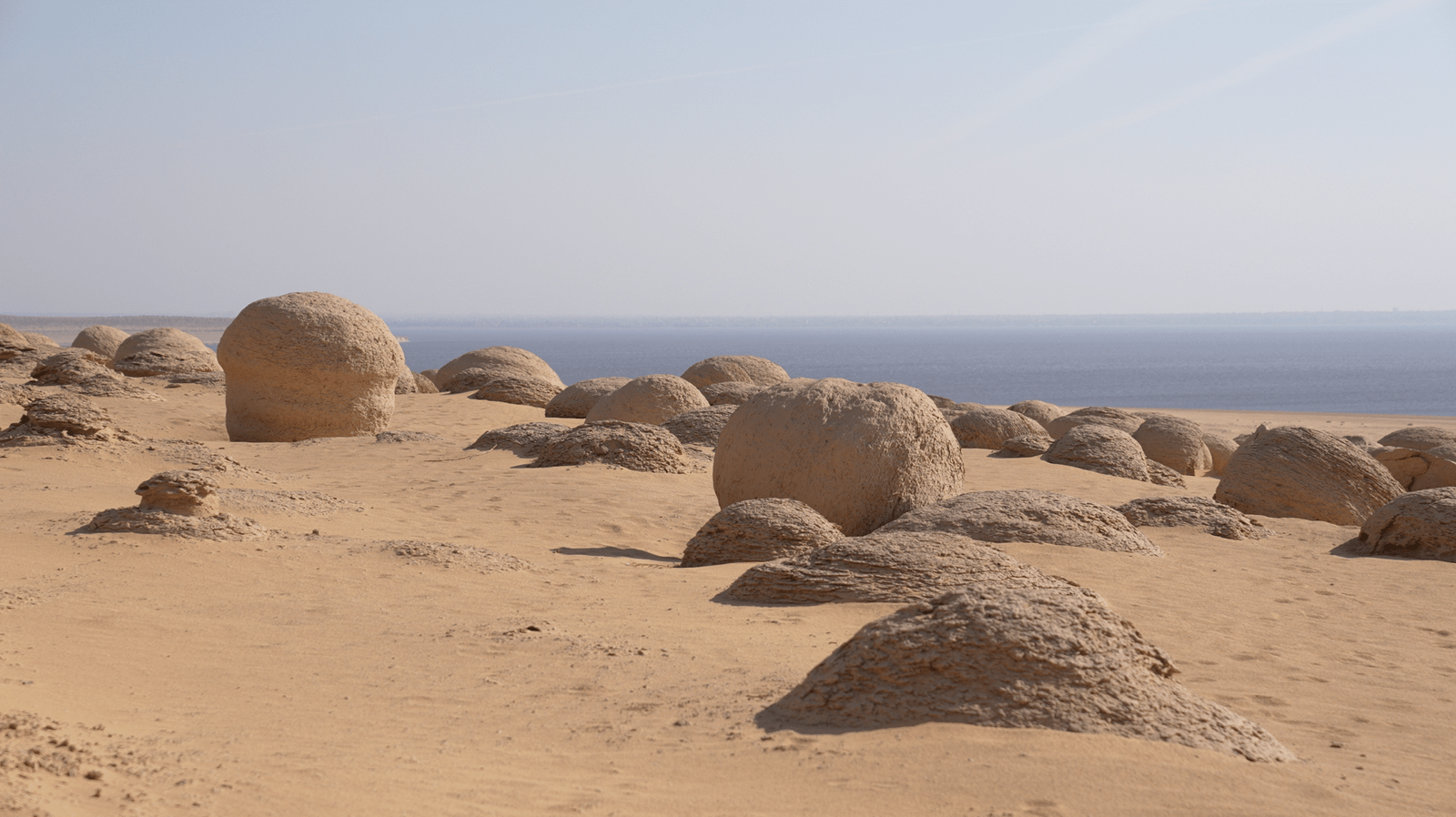
What is locally called “Rockmelon” refers to spherical or oval geological formations, scientifically known as concretions. This geomorphological phenomenon forms when minerals are deposited around a central core within sandstone layers. These rock formations appear in the area north of Lake Qarun, within ancient sandstone formations, particularly in a valley locally known as “Wadi Al-Bateekh” (Melon Valley).
The precise fact is that these masses have not rolled or moved from their original locations as is sometimes believed, but remain exactly where they formed millions of years ago. They are the result of chemical and geochemical changes within sedimentary rocks, where minerals such as calcium, iron, or silica gradually precipitate around a certain center, forming these nearly spherical shapes.
The size of these formations varies, with diameters ranging from about 20 centimeters to over two meters. They appear as large balls or eggs scattered across the ground or protruding from rock layers, creating a unique natural scene that captures attention.
This phenomenon is not merely aesthetically appealing, but also serves as a rare natural record showing the sedimentary formation conditions that once prevailed in the area. It represents a remarkable example of how water, minerals, and time interact to sculpt natural shapes.
Formation Process of Rockmelon
According to Wanas (2008), these rock concretions were formed in a coastal marine environment influenced by what is known as meteoric water—water originating from rain and floods—which is characterized by a higher content of carbon dioxide or acidity. This led to the dissolution of certain calcium sources such as plant roots or shells, which then concentrated in a specific part of the sandstone layer. The material cemented together, taking the shape of the void where it concentrated—either circular or oval—which may have been the location of plant roots, burrows of marine organisms, or cavities between ripple crests on the seabed at that time.
Prof. Hamdallah Wanas, Professor of Sedimentology, Department of Geology, Faculty of Science, Menoufia University.